LODGES HOTELS DIVING TOURS ADVENTURE OFFICES INFORMATION BOOK HERE
Travel to Papua New Guinea and enjoy our 
beautiful tropical resorts

TRANS NIUGINI TOURS is the leading inbound tour operator for tropical island vacations in Papua New Guinea. In addition to being an inbound Papua New Guinea tour operator we also own and operate a series of world famous Wilderness Lodges in PNG.

We own and operate our own mini coaches in Port Moresby, the Highlands and Madang. We operate our own boats on the Sepik and in Madang. We also have our own aircraft which link these Lodges. Whether going to wilderness lodges, scuba diving resorts, snorkelling vacations, ecotours and birdwatching tours, you can be assured of consistency in service while being looked after on one of Trans Niugini Tours.

Choose 
from a variety of Papua New Guinea tours, including bird watching tours, 
scuba diving resorts, snorkelling vacations, ecotours and wilderness lodges

Travel to Papua New Guinea and enjoy our beautiful 
tropical resorts

Indigenous History of New Guinea

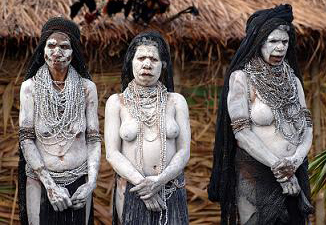
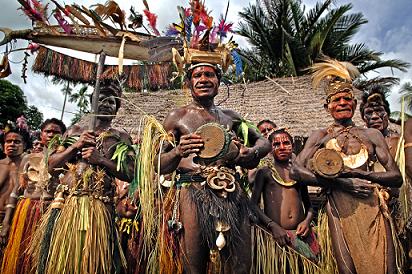
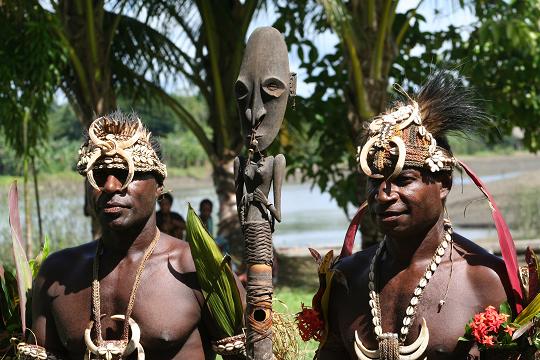
It is difficult to have a brief discussion about an indigenous history of New Guinea as the peoples are so varied (about 800 different languages) because of the lands enormously varied environments and geography, however following is a very brief outline: 40,000 years ago the greater Australian landmass had been colonised by Asian peoples. The amazing part about this colonisation was that it required watercraft. It was not until about 30,000 years later in the Mediterranean is there strong evidence of watercraft anywhere else. At the end of the last ice age, 10,000 years ago New Guinea was cut off from the Australian landmass by the Torres Straight, which triggered divergent development of the Australian Aborigines and New Guineans, with Australia being generally dry and arid than younger New Guinea, which is one of the wettest and most fertile places on Earth.

In the sixteenth and seventeenth centuries Europeans began to interact with the coastal people of New Guinea. It is thought that kaukau (sweet potato) - a staple in New Guinea - was introduced to the country by the Portuguese about four or five hundred years ago. It was not, however until the nineteenth century that colonial powers took control of New Guinea

Contemporary History of New Guinea
The Island of New Guinea was divided into three sections under colonial rule before WWI, those being Dutch New Guinea (now a province of Indonesia, and referred to as West Irian, Irian Jaya or West Papua), British New Guinea (the southern half of what is now Papua New Guinea) and German New Guinea (now the Northern half of Papua New Guinea as well as the major islands of New Britain, New Ireland and Bougainville).

Dutch New Guinea was administered by Holland from 1821 until 1962, in which for a brief time it was controlled by the United Nations until it was handed over to Indonesia in 1963, which it remains a part of. After being taken over by Indonesia it was known as Irian Jaya, but it's name has been changed to West Papua.

British New Guinea was designated a protectorate in 1884, but later changed to the status of a colony in 1888. In 1906 full responsibility for British New Guinea was handed over to the Commonwealth of Australia and was then called the T erritory of Papua. It was believed that Papua's future prosperity would be based on Agricultural Production.

Official German interest in New Guinea began in 1884, although some German traders and others had been active in the area prior to this. At first the Germans attempted to govern the colony through The New Guinea Company (based on the model of the East India companies of the seventeenth and eighteenth century). However, in 1895 The New Guinea Company handed over responsibility for the administration of the colony to the Imperial Judge, which was appointed by Berlin. Little development happened in the colony for a number of years, however in 1910 Rabaul, which had become the capital had good wharves, a botanic garden and well-planned streets. About six weeks after the outbreak of WWI in 1914, an Australian expeditionary force captured German New Guinea. Between 1914 and 1921 the Australian Military administered the captured colony, when it was given a mandate from the League of Nations in 1921 to administer the territory. At which point civil administration began in what as known as the Mandated Territory of New Guinea.

During the period between the World Wars, Australia administered both of the Territories separately. This marked a period of patrol expansion into the interior in which white explorers ventured into what was thought of as the uninhabited highlands. Peter Ryan of Melbourne University in Australia said about the period of 1941 to 1945 when The Japanese Imperial Army occupied most of New Guinea: "[that] changes occurred or were set in motion which far exceeded in their effects the original coming of the white man (which had been local and gradual)… Hunger, hardship, captivity and violent death were the lot of many of the indigenous people, for whom the war was an unrelieved disaster." During the war years the two territories were administered together by an organization called the Australian New Guinea Administrative Unit.

After the war a Provisional Civilian Administration was created to administer the two territories until the newly formed United Nations entered into a trusteeship agreement with Australia to administer the Trust Territory of New Guinea. The two territories still had a separate legal status - however they were administered together. In 1949 the Papua and New Guinea Act was passed by Australian parliament, which transferred some legislative, and executive powers Indigenous Papua New Guineans. However, even though there was a legislative council (with just over half being "official representatives"), the executive power resided in the Australian Governor-General and the Minister for Territories. This form of legislature lasted for eleven years until 1960. In 1961 the Legislative Council was reformed such that the majority were non-official representatives.

Between 1961 and independence in 1975 there was a gradual transfer of responsibility to indigenous Papua New Guineans. When the reformist Whitlam Labor Government of Australia came to power they pushed for early independence and this happened on the 16th of September 1975.

Since then Papua New Guinea has had full independence, it's enormous natural resources are the major driver of the national economy, however its economy remains typically third world, with the majority of exported goods being raw materials with little to no value adding done on-shore. The major exports of Papua New Guinea are gold, copper, gas, oil, timber, coffee, copra, cocoa and vanilla. The majority of the population still lives a subsistence or semi-subsistence lifestyle in the rural areas and people who do live in urban centres often retaining strong family and social connections to their villages and village.


Travel to Papua New Guinea and enjoy our beautiful 
tropical resorts

TNT Logo
CLICK HERE TO BOOK YOUR HOLIDAY IN NEW GUINEA TODAY!
Copyright(C)1996 - 2004 TRANS NIUGINI TOURS - travel@pngtours.com